Certified arborists deciding between tree removal and tree preservation rely on a formal tree assessment that evaluates three critical factors: the tree’s structural health, its likelihood of failure, and the potential damage to nearby targets. Arborists usually explore preservation first, recommending complete removal only when a tree is dead, terminally diseased, imminently hazardous, or when mitigation methods such as targeted pruning or tree cabling and bracing cannot lower the risk to an acceptable level.
For Toronto property owners, this decision involves balancing physical safety with strict municipal bylaws. This guide breaks down Loyal Tree’s assessment-first process, covering the definitive signs a tree needs to be removed, the specialized treatments available to save a dying tree, the rules for securing a Toronto tree removal permit, and when hazardous tree removal simply cannot wait.
Key Takeaways
- Assessment-Driven Decisions: Arborists evaluate a tree’s structural health, likelihood of failure, and nearby targets before making any recommendation.
- Removal as a Last Resort: Removal is only advised when a tree is dead, terminally diseased, or imminently hazardous, and no preservation technique can safely lower the risk.
- Proactive Preservation Solutions: Many trees can be saved using methods like cabling and bracing, crown reduction, root-zone care, and targeted pest treatments.
- Toronto Permit Bylaws: Permits are mandatory for removing private trees 30 cm or more in diameter, city street trees, or ravine trees. Healthy trees 61 cm+ face stricter “Distinctive Tree” rules.
- Exceptions for Hazards: Dead or dangerous trees may qualify for a permit exception, though City confirmation is required prior to removal unless immediate emergency action is necessary.
How Arborists Decide: The Tree Risk Assessment Framework
The removal-or-preservation decision rests on three variables. The arborist estimates:
- The likelihood that the tree, or a specific part of it, will fail within a stated time frame.
- The likelihood that the failure would strike a target like a house, a sidewalk, a parked car, or a utility line.
- The severity of the consequences if that strike occurs.
These three estimates combine to create a risk rating ranging from low to extreme. For example, a tree with a serious defect in an open corner of a ravine lot may rate ‘low’ because nothing is beneath it. Conversely, a tree with a smaller defect hanging directly over a bedroom roof may rate ‘high’.
Three Levels of Arborist Tree Assessment in Toronto
- Level 1, limited visual
a walk-by or drive-by inspection of a large population of trees, typically after a storm, to flag obvious hazards such as split trunks and hangers.
- Level 2, basic
a 360-degree ground inspection of the crown, trunk, root collar, and visible roots, including sounding the trunk with a mallet and probing cavities. This is the standard for a Toronto arborist report.
- Level 3, advanced
instruments and specialized access when a Level 2 inspection cannot establish how much sound wood remains. Resistance drilling, sonic tomography, aerial inspection, and root-collar excavation fall here. It is reserved for high-value trees where the extra cost changes the decision.
Why Removal is Considered As a Final Option
The ISA’s guidance for tree owners on managing hazards and risk lists five options:
- remove the target
- prune the tree
- cable and brace it
- provide routine care
- remove the tree
An arborist considers these options based on the tree’s condition, the likelihood of failure, and the potential consequences. Depending on the situation, the arborist may recommend pruning, cabling and bracing, routine care, moving the target, or removal. The goal is to reduce the risk to an acceptable level while preserving the tree whenever reasonably possible. Removal is appropriate, in the ISA’s words, for “some trees with unacceptable levels of risk.”
A defensible recommendation therefore records why the less drastic options were rejected, not only why removal was chosen. That written reasoning is also what the City of Toronto expects in an arborist report. It is the main difference between an assessment and a quote, a distinction covered in Loyal Tree’s guide to a certified arborist versus a tree service.
Signs a Tree Needs to Be Removed
A tree needs to be removed when its defects cannot be corrected and the risk they create is unacceptable where the tree stands. The signs below raise the likelihood of failure sharply; none of them, on its own, is a verdict. A conk on the trunk tells an arborist to test how far the decay extends, not to schedule a removal.
Structural Defects
- A trunk cavity or internal decay that leaves only a thin shell of sound wood, confirmed by sounding or resistance drilling.
- Cracks that run into the trunk, or a codominant union with included bark that has begun to separate.
- A lean that has recently increased, especially with soil heaving or cracking on the opposite side of the root plate.
Root and Soil Problems
- Fungal fruiting bodies at the base or on surface roots, which indicate root or butt rot.
- Roots severed by excavation inside the Tree Protection Zone, or girdling roots that have constricted the trunk.
Health in Irreversible Decline
- Crown dieback that advances over successive seasons, with epicormic sprouting along the trunk.
- Bark loss over large areas, or a disease the tree cannot recover from.
Toronto Specific Removal Factors
Emerald ash borer, present in Toronto since 2007, has killed most of the region’s untreated ash; a dead ash dries and becomes brittle quickly, which makes it hazardous to climb and argues for prompt hazardous tree removal rather than monitoring.
Oak wilt, first confirmed in Canada in 2023 at three Ontario sites, kills trees in the red oak group within a single season. It has not been confirmed in Toronto, but the Canadian Food Inspection Agency can order removal of infected and adjacent oaks, so an oak with sudden mid-summer wilting from the top of the crown should be reported and assessed, not pruned.
When Tree Preservation Is the Better Decision
Preservation is the right call when a tree is viable, its defects can be managed, and the remaining risk is acceptable for the location. Because Toronto’s bylaws heavily protect mature trees, an arborist will always exhaust preservation options before applying for a removal permit.
Tree Cabling and Bracing for Structural Weak Points
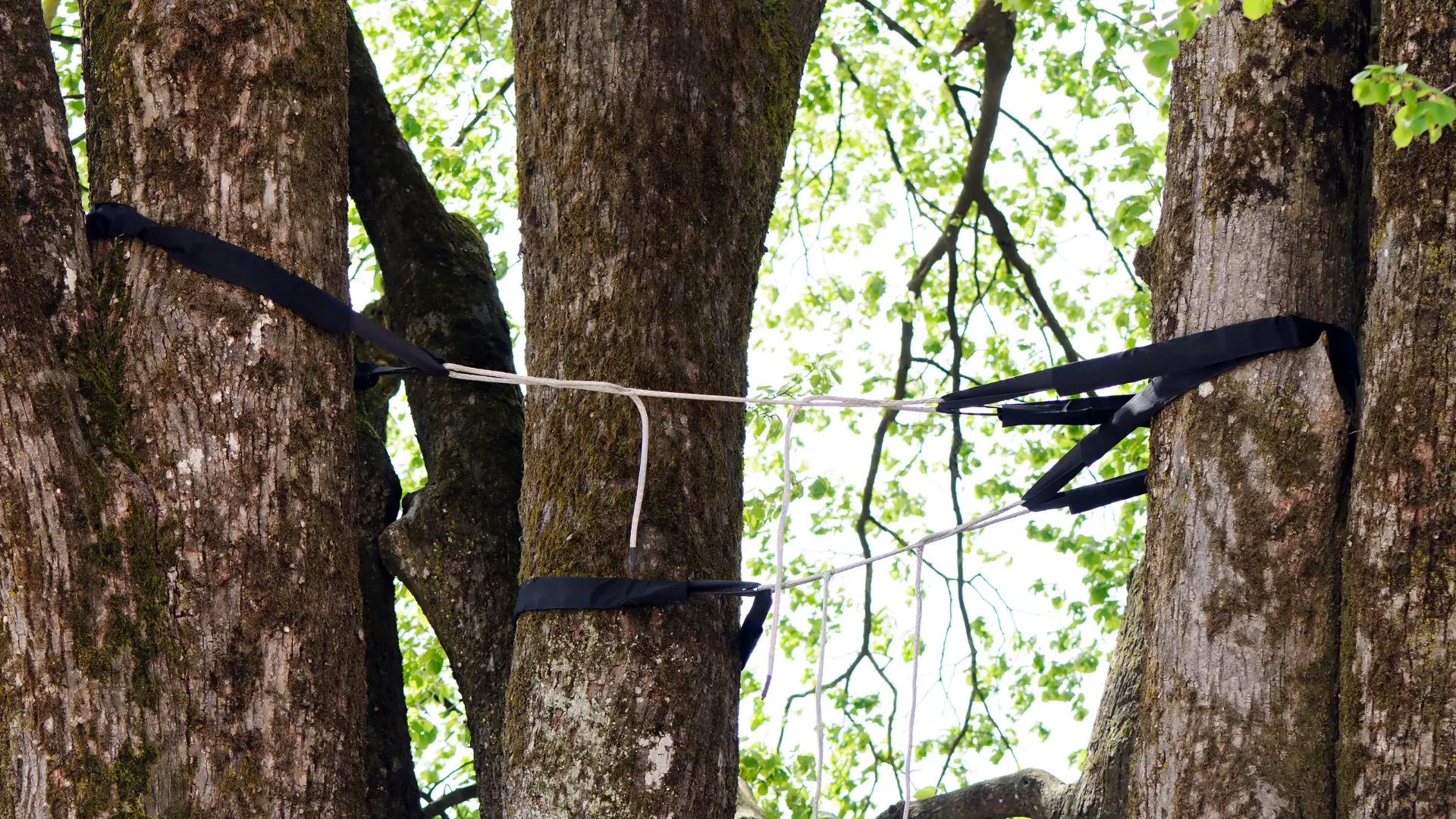
Tree cabling and bracing is ideal for an otherwise healthy tree with one specific defect, such as a split limb, a codominant union, or an over-extended leader.
- How it works: Cables installed in the upper canopy limit how far the stems sway in the wind, while threaded brace rods reinforce the weak union itself.
- Prerequisites: The anchor wood must be completely sound, requiring thorough decay testing before installation.
- Maintenance: Supports reduce risk but aren’t a guarantee against failure. Loyal Tree inspects and adjusts our installed systems every one to three years as the tree grows.
Pruning and Crown Reduction
Removing deadwood addresses the most common small-failure hazards, while crown reduction lowers the weight and leverage on weak branches below.
- Bylaw Compliance: Toronto classifies excessive canopy removal or improper pruning as a “tree injury.” Reductions must strictly follow ANSI A300 arboricultural standards.
- Oak Wilt Restrictions: The Canadian Food Inspection Agency advises against pruning oak trees between April and November to help prevent the spread of oak wilt. If you suspect infection, contact the CFIA for guidance before pruning or removing the tree.
Saving a Dying Tree: Root Zone and Plant Health Care
Most “dying” trees in Toronto yards are actually declining from the ground up. Compacted soil, construction damage, or girdling roots slowly starve the canopy. Because the canopy is needed to rebuild the roots, arborists avoid thinning it and focus on treating the source:
- Root Treatments: Interventions include root-collar excavation with air tools, soil decompaction, drainage correction, deep watering, and applying 5 to 10 cm of organic mulch.
- Pest Management: Systemic treatments, such as routine TreeAzin injections, can protect a still-healthy ash tree from the emerald ash borer.
Alternative Preservation Strategies
Two additional options belong in every professional assessment:
- Move the Target: Relocating a play structure, shed, or parking spot can instantly lower the tree’s risk rating to an acceptable level without touching the tree itself.
- Leverage City Incentives: Toronto’s new Distinctive Tree Maintenance Incentive Program (running through 2026 and 2027) helps residents offset the costs of maintaining healthy private trees over 61 cm in diameter.
Loyal Tree provides a full range of tree services in Toronto, including preservation and removal services. If a tree on your property shows any of the signs described above, the appropriate next step is an on-site arborist assessment.
Tree Preservation vs Tree Removal Comparison Table
| Aspect | Tree Preservation | Tree Removal |
| When to Choose | Tree is viable; defects can be managed; remaining risk is acceptable. | Tree is 100% dead, terminally diseased, or poses an unmanageable risk. |
| Key Indicators | Early root decline, a single weak point (e.g., split limb), or treatable pests. | Extensive internal decay, severe leaning, dead ash, oak wilt, or imminent hazard. |
| Arborist Methods | Cabling and bracing, crown reduction, soil decompaction, or systemic pest injections. | Precision sectional dismantling, crane lifting, and sustainable timber salvaging. |
| Toronto Permit Rules | Routine pruning requires no permit (must strictly follow ANSI A300 standards). | Mandatory for private trees ≥ 30cm, all city street trees, and all ravine trees. |
| Hazards & Exceptions | Relocating the target (e.g., moving a shed) lowers risk without cutting. | Dead or highly dangerous trees qualify for permit exceptions (City confirmation and photos required). |
| Bylaw Implications | City incentives can help offset maintenance costs for trees 61cm+. | Mandatory replacement planting; unauthorized removal fines range from 500–100,000. |
Toronto Tree Removal Permits: How the Bylaw Shapes the Decision
Toronto’s tree bylaws turn the arborist’s assessment into a regulatory document. Under Municipal Code Chapter 813, a Toronto tree removal permit is required to injure or remove any private tree 30 cm or more in diameter at 1.4 m above ground. Chapter 658 protects every tree in a designated ravine or natural feature, regardless of size.
Toronto’s rules fall into the category the ISA calls “tree protection ordinances”: a permit must be obtained before a protected tree is removed, and the burden is on the owner to justify it.
- The Application: Requires an arborist report covering the tree’s location, species, size, condition, structural integrity, disease, and health, plus photographs and a replanting plan.
- Replacement Obligations: Replacement planting is mandatory. Where there is no space, the City accepts cash-in-lieu of $583 per tree.
- Valid Reasons: The City accepts applications for trees in poor condition that cannot be kept healthy and safe, or that are causing structural damage to a load-bearing structure or roof. It does not accept nuisance reasons such as leaves, shade, or roots in a well-built foundation.
An assessment that documents the condition is therefore the recognized basis for an approvable application, which is why an arborist report is worth budgeting for.
Dead, Dying, and Hazardous Trees
A tree that is 100 per cent dead, terminally diseased, or imminently hazardous can qualify for a permit exception rather than a full permit. The owner submits the tree’s size, species, condition, photos, and location to the local Tree Protection and Plan Review office and must receive the City’s confirmation before removal, unless immediate work is required to eliminate a dangerous situation. A tree that is merely in “poor condition” still needs a full permit.
What Changed on September 1, 2026
- Distinctive Trees: Healthy private and ravine trees over 61 cm in diameter are now a “Distinctive Tree” category with added protection, identified by City staff and considered in every permit application affecting them.
- Stump Evidence: A stump diameter of 40 cm or more can now be used as evidence when a removed tree’s trunk cannot be measured.
- Stricter Replacements: Replacement ratios for unauthorized removals are now diameter-based, starting at 5:1.
- Future Threshold Change: City Council has endorsed lowering the private-tree threshold from 30 cm to 20 cm, pending a 2027 implementation report. It has not yet taken effect.
Note: Removing a protected tree without a permit carries a fine of $500 to $100,000 per tree, plus a special fine of $100,000 where the offender benefited financially. The City does not accept applications after the fact. Bylaw details above are current as of October 2026 from the City of Toronto’s Tree Bylaw Review.
Hazardous Tree Removal: When Timing Overrides Preservation
The preservation-first approach assumes you have time for a proper assessment. However, an imminently hazardous tree removes that luxury. When the likelihood of failure is a certainty rather than an estimate, safety and timing must take precedence.
Recognizing an Imminent Hazard
Immediate action is required when a tree poses a direct, active threat, such as:
- A trunk split by severe ice loading or high winds.
- An uprooted tree with a lifted root plate, leaning toward a structure.
- A massive broken limb hanging directly over a walkway.
- A tree actively resting on a roof or utility line.
Navigating City Bylaws During an Emergency
Toronto’s tree bylaws are designed to accommodate true emergencies. When danger is imminent:
- Act First, Confirm Later: The City allows property owners to proceed with eliminating the danger before a permit exception is officially confirmed.
- Document Everything: You must take clear photographs of the hazard before any work begins. These photos serve as your mandatory proof to support the permit exception afterward.
Safe Execution and Emergency Response
How a dangerous tree is removed matters just as much as the decision to remove it.
- Precision Dismantling: Trees without a safe drop zone are dismantled in sections using specialized rigging, or lifted out by crane to protect the structures below.
- Utility Coordination: Removals near energized power lines are strictly coordinated with local utilities and never improvised.
- Expert Intervention: The ISA strongly advises against DIY cleanup after storm damage. Prioritize your safety, stay clear, and hire a certified arborist. Loyal Tree offers 24-hour emergency tree services for exactly these high-risk scenarios.
- Timber Salvaging: Whenever the trunk is sound enough, Loyal Tree salvages the wood through our in-house mill rather than simply chipping it—ensuring even a complete removal returns value to the environment and the property.
Why Choose Loyal Tree
Loyal Tree bridges the gap between expert assessment and safe execution, ensuring the arborist who documents a defect is fully accountable for the final outcome.
- Local, fully insured Toronto-based company.
- Certified arborists perform assessments before recommending work.
- Total accountability from initial assessment to final execution.
- Expert preparation of Toronto tree removal permit reports.
- Comprehensive tree preservation and safe removal services.
- 24/7 emergency response for hazardous tree situations.
- Sustainable timber salvaging using our in-house mill.
If a tree on your property shows any of the signs described above, the appropriate next step is an on-site arborist assessment. Loyal Tree will document the tree’s condition, explain whether preservation or removal is justified and why, and prepare the report the City requires if a permit or exception is needed. Call 647-283-8556 or contact Loyal Tree to schedule an assessment.
Frequently Asked Questions
How do arborists decide whether to remove a tree?
Arborists use a tree risk assessment. They estimate the likelihood that the tree, or part of it, will fail within a set time frame, the likelihood that it would strike a target, and the consequences if it did. Removal is recommended only when pruning, cabling and bracing, root-zone care, or moving the target cannot reduce that risk to an acceptable level, or when the tree is dead or terminally diseased.
What are the signs a tree needs to be removed?
The strongest signs are extensive trunk decay with little sound wood, cracks running into the trunk, a codominant union that is separating, a lean that has recently increased with soil heaving at the base, fungal conks on the roots or trunk, and crown dieback that worsens each season. Each sign calls for testing by an arborist; the combination, plus what the tree could hit, is what justifies removal.
Can a dying tree be saved?
Often, if the decline is caught early and the cause is in the root zone. Compacted soil, raised grades, girdling roots, and construction damage respond to root-collar excavation, soil decompaction, mulching, and deep watering. Ash trees can be protected from emerald ash borer with scheduled TreeAzin injections. A tree with advanced structural decay or a terminal disease such as oak wilt cannot be saved and should be assessed for removal.
Do I need a permit to remove a tree in Toronto?
Yes, if the tree is on private property and measures 30 cm or more in diameter at 1.4 m above ground, if it is a City street tree of any size, or if it stands in a designated ravine or natural feature. Trees under 30 cm on private land outside ravines need no permit. Applications require an arborist report, photos, and a replanting plan, and replacement planting is mandatory.
Can I remove a dead tree without a permit in Toronto?
You do not need a standard permit, but you are legally required to apply for and receive an official “Permit Exception” from the City before cutting it down. You must submit the species, size, condition, photos, and location to the Tree Protection and Plan Review office. The only time you can cut before receiving this confirmation is if the tree poses an immediate, active danger (though photos must still be taken first).
What happens if you cut down a tree without a permit in Toronto?
The City investigates, issues Stop Work Orders or Orders to Comply, and may prosecute. Fines run from $500 to $100,000 per tree, with a special fine of $100,000 and additional fines where the offender profited. Replacement planting is required at ratios starting at 5:1, and contravention inspection fees are charged per tree. The City does not accept permit applications after the fact.
How much does tree removal cost in Toronto?
Loyal Tree’s published range for arborist services in Toronto is $300 to $3,000, with large or emergency removals at the upper end. Price depends on tree size, access, proximity to structures and utility lines, rigging or crane requirements, and disposal volume. The arborist report, the City’s permit application fee, and replacement planting or $583 cash-in-lieu per tree are separate costs.
Who is responsible for a dangerous tree in Toronto?
The property owner. Toronto’s bylaw makes owners responsible for maintaining the trees on their land and for arranging removal of a private tree that is imminently hazardous. A boundary tree is owned jointly, so any removal needs the consent of every owner. A documented arborist assessment is important evidence if a tree failure leads to a dispute with a neighbour or an insurer.