
A split tree can often be saved if the crack is recent and the surrounding wood is free of decay. To fix a split tree trunk, arborists use a three-step structural repair: pruning to reduce weight on the failing stems, securing support cables in the upper canopy to draw the split together, and installing threaded steel brace rods directly through the trunk. However, if the stem has completely separated or decay is severe, tree preservation is no longer safe. This requires tree removal in Toronto, which involves navigating specific City bylaws and permit exceptions for hazardous trees. This guide breaks down what to do in the first 60 minutes, how professionals evaluate structural damage, and the exact protocols for both permanent repair and legal removal.
Key Takeaways
- Can a split tree be saved? The best candidates have a recent split, little or no decay, and sound wood on both sides of the crack to hold hardware.
- How is it repaired? Arborists install threaded steel brace rods through the split, add support cables higher in the crown, and prune to reduce load. The split wood does not fuse; the hardware holds it.
- When is removal necessary? When a stem has fully separated, the split reaches the base of the trunk, decay is extensive, or a failure would strike a house, sidewalk or neighbouring property.
- Is a permit required in Toronto? Private trees 30 cm or more in diameter at 1.4 m above ground are protected. An imminently hazardous tree can qualify for a permit exception that the City confirms.
- What should be avoided? Wound paint, concrete, rope and ratchet straps do not repair a split trunk.
What to Do Immediately After a Tree Splits
A split stem is under load and can move without warning. Before considering repair, reduce the exposure of people and property.
- Clear the area. Keep people, pets and vehicles away from the damaged stems, to a distance at least equal to the height of the tree.
- Stay away from wires. ISA guidance is never to approach tree parts touching utility lines. Call your local electricity provider immediately; this is Toronto Hydro within the city, or providers like Hydro One or Alectra Utilities if you are elsewhere in the GTA.
- Photograph the damage. Close and wide views support an insurance claim and any request to the City.
- Check who owns the tree. Trees on City streets are protected at any size; report damage to 311 rather than cutting.
- Do not climb, cut or strap the tree. Book an inspection with an ISA Certified Arborist.
Why Tree Trunks Split
A split tree trunk is a trunk or major stem with a longitudinal crack or a separation, often occurring where two codominant stems meet. The International Society of Arboriculture’s Recognizing Tree Risk brochure identifies codominant stems as frequent failure points, and lists longitudinal cracks in the trunk or at branch unions among the defects that warrant professional evaluation. Codominant stems are two stems of similar size rising from one point. Bark trapped inside the union, known as included bark, prevents the stems from forming a continuous wood connection. Wind, wet snow or ice then loads a joint that was never strongly attached.
In Toronto, silver maple, Norway maple, Manitoba maple and willow often develop this form, and Loyal Tree’s guide to the signs a tree needs cabling describes the warnings that usually appear beforehand. Not every crack is a failing union. Frost cracks, vertical fissures caused by rapid winter temperature swings, can admit decay but seldom signal imminent failure on their own.
Can the Split Be Repaired? What an Arborist Evaluates
General storm-recovery guidance from forestry agencies,places a split trunk among the conditions where replacement should be considered. An on-site structural assessment can identify the narrower group of splits where a support system is a realistic option. These are usually failures at a codominant union with sound wood on both sides.
| Assessment Factor | Conditions Favouring Preservation | Conditions Pointing to Removal |
| Severity of the Split | Both stems remain attached; the crack is confined to the union or upper trunk. | A stem has separated completely, is hanging in the crown, or the split runs down to the base/root flare. |
| Wood Condition | The split is recent; exposed wood shows no discoloration, cavities, or fungal growth. | Decay, cavities, or fungal fruiting bodies are present, leaving too little sound wood to anchor repair hardware. |
| Canopy & Bark | A substantial portion of the crown remains structurally sound, with limited major stem or bark damage and enough healthy tissue to support continued growth. Severe crown loss, extensive bark damage or major structural defects may reduce the feasibility of preservation. | Severe structural loss (implied by stem separation) compromising tree survival. |
| Root Stability | The root plate is stable with no signs of soil cracking or heaving. | Root plate instability or damage reaching the root flare. |
| Risk to Surroundings | The tree is situated in a location where a potential failure does not threaten high-value targets. | The tree stands over a bedroom, sidewalk, or neighboring lot (support systems do not guarantee against failure). |
Loyal Tree’s guide to tree cabling vs. removal compares these two paths in more detail.
How Arborists Fix a Split Tree Trunk
A structural repair generally proceeds in a sequence.
- Load Reduction Pruning
Reduction cuts shorten and lighten the split stems. University of Florida guidance recommends completing this pruning immediately before hardware is installed.
- Brace Rods
Threaded steel rods are drilled through both halves of the split, in or close to the union, and secured with washers and nuts. Rigid bracing is the usual response where stems have already begun to separate.
- Support Cables
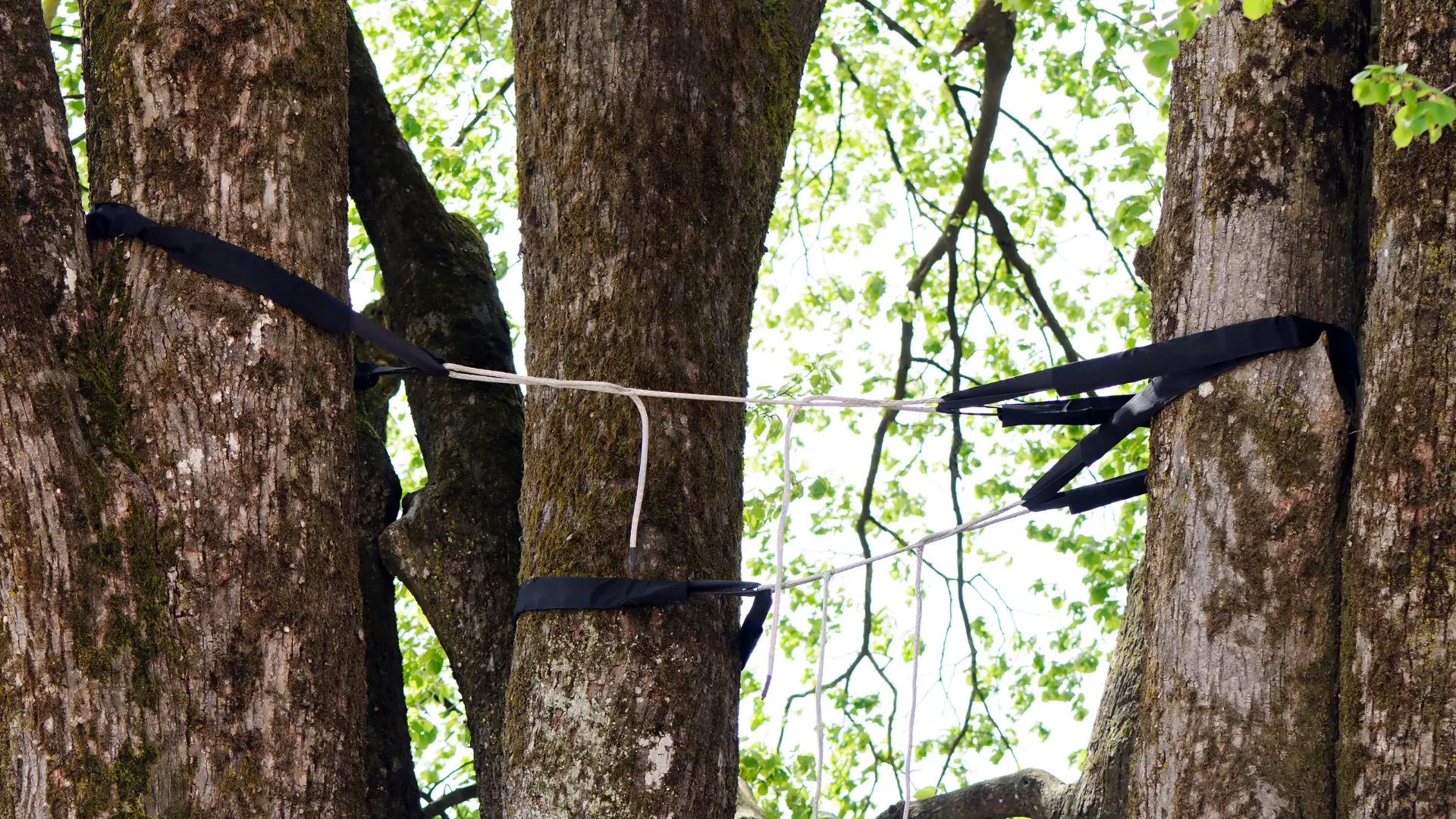
Steel or synthetic cables are anchored about two-thirds of the way from the union to the branch tips, limiting how far the stems can spread under wind or ice load.
- Inspection Schedule
Loyal Tree recommends re-inspection every one to three years, because the tree keeps growing around fixed hardware.
The repair does not necessarily rejoin the wood. Trees respond to injury by compartmentalization, walling off damaged tissue and growing woundwood along the crack margins, so the support system becomes a permanent part of the tree.
Loyal Tree’s tree cabling and bracing service covers assessment, installation and follow-up inspection. Owners of large trees should also note the City’s Distinctive Tree Maintenance Incentive Program pilot, which runs through 2027 and is intended to help residents with maintenance costs for healthy private trees over 61 cm in diameter.
Repairs That Do Not Work
- Wound paint or sealant. ISA consumer guidance reports that research has not shown dressings to reduce decay or speed wound closure.
- Concrete or foam filler. Filling adds no structural strength, traps moisture and hides decay from later inspection.
- Rope, chain or ratchet straps. Anything left wrapped around a trunk girdles it as the stem grows.
When Removal Is Necessary: Toronto Permit Rules for Split Trees
If the assessment points to tree removal in Toronto, City bylaws determine how quickly work can proceed. The main rules on the City’s Tree & Ravine Protection pages are as follows.
- Private trees measuring 30 cm or more in diameter at breast height (DBH) remain protected under Toronto’s Private Tree By-law.
- Starting September 1, 2026, Toronto also introduced a Distinctive Tree category for healthy private trees measuring more than 61 cm DBH, giving these trees additional protection during permit review.
- Trees on City streets and in ravine-protected areas are protected at any size.
- A hazardous tree may qualify for an exception to the normal permit process when immediate work is necessary to eliminate a danger to life or property. Homeowners should confirm the applicable City requirements before arranging removal whenever circumstances allow. A damaged or declining tree does not automatically qualify as an emergency exception.
- The owner submits the tree’s size, species, condition, photos, and location to the district Tree Protection and Plan Review office; an arborist report is recommended but not mandatory.
- The City’s confirmation must be received before removal, unless immediate work is required to eliminate a dangerous situation.
- A damaged tree that is not imminently hazardous still requires a permit application.
Loyal Tree’s Toronto tree removal permit guide explains fines and replanting requirements, and its arborists advise on which pathway applies when preparing a tree removal estimate.
How Loyal Tree Assesses Split Trees
Loyal Tree’s ISA Certified Arborists inspect a split tree against the defect categories the ISA publishes: cracks, codominant unions, decay, root stability and the targets within reach of a failure. The company installs support systems, performs removals, prepares arborist reports and assists with City permit applications, so the recommendation follows the inspection findings rather than the limits of a single service. Crews are covered by WSIB and liability insurance.
Why Choose Loyal Tree
- Highly trained ISA Certified Arborists.
- Fully covered by WSIB and liability insurance.
- Assist with arborist reports and City permit applications.
- Offer complete support systems and safe tree removals.
- Base recommendations on thorough, on-site structural assessments.
- Provide free consultations and tree service estimates.
- Serve homeowners across Toronto and the GTA.
Have Loyal Tree’s ISA Certified Arborists Assess the Split Before You Decide
Whether a split tree is braced or removed depends on findings that cannot be judged from the ground: the depth of the crack, the soundness of the wood behind it, and what the tree would strike if it failed. An early inspection keeps both options open, because exposed wood deteriorates and City confirmation or a permit must be in place before most removals.
Loyal Tree provides tree services in Toronto and across the GTA, including free consultations and estimates. To arrange an assessment of a split or cracked tree, contact us today by email at info@loyaltree.ca or by phone at 647-283-8556.
Frequently Asked Questions
Can a tree survive with a split trunk?
Yes, in many cases. A tree with a split trunk can live for decades when the crown is largely intact, the exposed wood is free of decay, and an arborist installs brace rods and cables to carry the load the damaged union can no longer bear. Survival is unlikely when a stem has separated completely or the split reaches the root flare.
How do you fix a split tree trunk?
A split tree trunk is not repaired with one standard method. An arborist first assesses the crack, stem attachment, decay, root stability and potential targets. Depending on the findings, treatment may include selective pruning, structural bracing, cabling, or a combination of these methods. The goal is to reduce movement and manage the risk of further failure; support hardware does not guarantee that the tree will remain structurally safe.
Will a split tree trunk heal on its own?
No. Wood that has split does not grow back together. A tree responds by compartmentalizing the wound and forming woundwood along the edges of the crack, which can eventually cover the surface without restoring strength. Without mechanical support, each wind or ice event can widen the split, and the exposed interior wood becomes an entry point for decay fungi.
Can you bolt a split tree back together?
Yes, when an arborist does it with the correct hardware. Threaded steel through-rods are drilled through both halves of the split and secured with washers and nuts, and cables are usually added higher in the crown. Hardware-store bolts, lag screws and lumber are not substitutes, because undersized or poorly placed hardware can fail under the leverage of a mature crown.
Should I seal or wrap a split in a tree trunk?
No. Research summarized by the International Society of Arboriculture has not shown wound dressings to reduce decay or speed closure, and sealants can hold moisture against the wood. Rope, wire or straps left around a trunk will girdle it as it grows. Leave the wound open, keep the area clear, and have the split inspected by an arborist.
Is a tree with a split trunk dangerous?
It can be. The ISA lists cracks and splits in the trunk or at branch unions among the defects associated with tree failure, and a split stem can drop with little warning in wind. The level of risk depends on the size of the affected part and what lies beneath it. Keep people and vehicles clear until an arborist inspects the tree.
Do I need a permit to remove a split tree in Toronto?
In most cases, yes. A permit is required when a private tree is 30 cm or more in diameter at 1.4 m above ground, or any size within a ravine-protected area. An imminently hazardous tree can qualify for a permit exception, but the City must confirm it before removal unless immediate work is needed to eliminate a dangerous situation. Report split City street trees to 311.
How much does it cost to fix or remove a split tree in Toronto?
Cost depends on tree size, access, the number of rods and cables, and permit requirements. Loyal Tree’s published guidance places tree cabling in Toronto at roughly $300 to $800 per cable, with bracing and pruning priced separately. Removal is quoted after a site visit. Loyal Tree provides free consultations and a tree removal estimate on request.