During a professional tree risk assessment in Toronto, an ISA-certified arborist conducts a structured, 360-degree visual inspection of a tree’s roots, trunk, and crown to identify structural defects. The arborist systematically evaluates site conditions, identifies potential targets in the fall zone like homes, vehicles, or power lines, and rates the likelihood of tree failure against the potential consequences of an impact.
This process generates an official risk rating of low, moderate, high, or extreme, along with safe mitigation options like pruning, cabling, or removal that comply with Toronto’s local tree protection bylaws. Because the City of Toronto does not inspect private trees, proactive hazard management before storm season is entirely the homeowner’s responsibility. This guide breaks down the step-by-step assessment process, explains how it differs from a standard health check, and outlines your options once you have your results.
Key Takeaways
- A tree risk assessment combines three judgments: likelihood of failure, likelihood of impacting a target, and consequences. The output is a rating of low, moderate, high, or extreme.
- Most residential inspections are Level 2: a ground-based, 360-degree inspection of roots, trunk, and crown.
- Risk and health are separate questions. A vigorous tree can carry a serious structural defect.
- In Toronto, private trees 30 cm or more in diameter are bylaw-protected, so removal usually requires a permit or a City-confirmed exception.
- The arborist rates the risk and lists options; the owner decides how much risk is acceptable.
What Is a Tree Risk Assessment?
The recognized method is set out in the International Society of Arboriculture’s (ISA) Best Management Practices: Tree Risk Assessment. It replaces a “safe or unsafe” opinion with a documented rating for each condition of concern over a stated time frame.
Tree Risk Assessment vs. Tree Health Assessment
A tree health assessment asks whether a tree is thriving: vigour, pests, disease, and soil conditions. A tree risk assessment asks whether a part is likely to fail and strike something. A full-crowned silver maple with included bark between two large stems over a roof can be healthy and high risk at once. Loyal Tree’s guides on how Toronto arborists assess and manage tree health and inspecting Toronto trees for pests and diseases cover tree health and inspection processes.
What Happens During a Professional Tree Risk Assessment?
| Assessment Level | Best Used For (Scope) | Inspection Method & Tools | Key Focus Areas | Typical Output / Report |
| Level 1: Limited Visual | Large properties, municipal parks, or initial triage of many trees. | Walk-by or drive-by visual screen. Usually observed from one side or a specific vantage point without getting up close. | Identifying obvious, severe defects like dead trees, massive hanging branches, or imminent failures. | A basic triage list noting which trees require immediate action or a closer, Level 2 assessment. |
| Level 2: Basic Visual | Residential properties and standard homeowner risk evaluations. | Ground-based, 360-degree walk-around. Uses basic hand tools (mallet for sounding trunks, binoculars, soil probe). | Site/Targets: Wind exposure, soil saturation, structures in the fall zone.
Roots: Soil heaving, severed roots, fungal bodies. Trunk: Cracks, cavities, cankers. Crown: Weak unions, deadwood, overextended limbs. |
A documented assessment describing the scope, observed defects, risk rating, targets, and recommended mitigation measures. A formal arborist report can be prepared when documentation is required for a permit, construction project, insurance matter, or property transaction. |
| Level 3: Advanced | High-value, historic trees, or when a Level 2 assessment flags a defect but cannot determine its severity from the outside. | Highly specialized invasive or non-invasive testing (e.g., aerial climbing inspections, resistance drilling, sonic tomography, root collar excavation). | Measuring the exact extent of internal decay, mapping hollow cavities, or evaluating subterranean root system integrity. | Deep diagnostic data (often including decay maps or graphs), precise structural integrity findings, and definitive recommendations. |
For many Toronto residential properties, a Level 2, ground-based visual assessment is an appropriate starting point when a detailed evaluation of an individual tree is needed. The appropriate assessment level depends on the scope, tree, site conditions, targets, and information available. A Level 3 assessment may be recommended when additional diagnostic information is needed to evaluate a defect that cannot be adequately assessed from the ground.
When Should You Get a Tree Risk Assessment in Toronto?
Consider a tree risk assessment if you notice a new or worsening lean, large dead branches, cracks or cavities, weak branch unions, fungal growth near the trunk base, exposed or damaged roots, or signs of root-plate movement. An assessment can also be useful after severe wind, ice or snow, following excavation or construction near a tree, or when a mature tree is located close to a home, driveway, walkway or other frequently occupied area.
Toronto recommends that private-property owners have storm-damaged trees assessed by an arborist, and the City advises regular inspection for dead branches and structural weaknesses.
How Arborists Rate Tree Risk
The ISA method uses two matrices to combine three categorized inputs:
- Likelihood of failure: improbable, possible, probable, or imminent.
- Likelihood of impacting a target: very low, low, medium, or high.
- Consequences of impact: negligible, minor, significant, or severe.
The first two are combined, then weighed against consequences to produce a rating of low, moderate, high, or extreme. The same dead limb can be low risk over a back fence line and high risk over a front walkway. The owner, not the arborist, decides how much risk is acceptable, so a sound report states the residual risk that remains after each option.
What Happens After the Assessment: Mitigation Options
Removal is one option among several:
- Pruning: removing dead or defective branches, or reducing end weight on overextended limbs. A search for “tree pruning near me” is a reasonable next step once an assessment has specified the cuts.
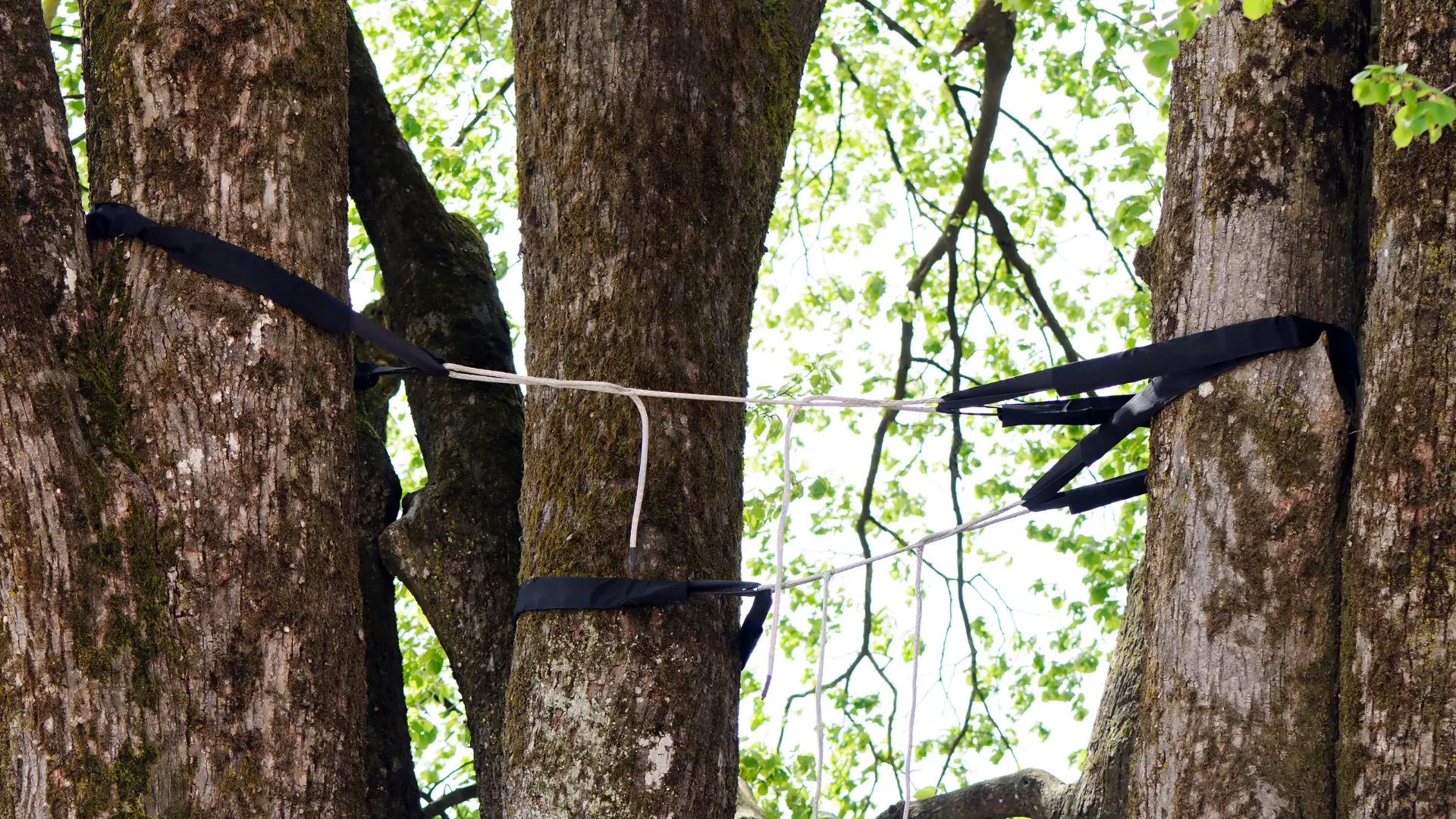
- Cabling and bracing: supplemental support for weak unions in otherwise sound trees.
- Target management: moving a play structure, parking spot, or seating out of the fall zone.
- Monitoring: re-inspection at a set interval or after severe weather.
- Removal: where risk cannot be reduced to a level the owner accepts. Loyal Tree provides tree removal in Toronto and operates alongside a small-scale mill that salvages timber from removed urban trees.
When documentation is needed for a permit, insurer, or property sale, the findings can be issued as a formal arborist report.
Toronto Bylaws That Shape What Happens Next
The City of Toronto’s tree and ravine protection rules determine what an owner may do after an assessment:
- Private trees 30 cm or more in diameter, measured 1.4 m above ground, require a permit to injure or remove. City street trees of any size and all trees in ravine-protected areas are also protected.
- Pruning that follows good arboricultural practice does not require a permit.
- Imminently hazardous, dead, and terminally diseased trees are handled through permit exceptions instead of standard permits. A tree that is only in poor condition still requires a permit.
- Amendments in effect since September 1, 2026, add a “Distinctive Tree” category for any tree over 61 cm in diameter. This category is supported by a new maintenance incentive pilot program running through 2027 to help private owners care for large, healthy trees. City staff are also currently reviewing a proposal to lower the standard protected threshold from 30 cm to 20 cm, with findings to be reported back in 2027.
Loyal Tree’s homeowner’s guide to municipal tree bylaws gives further background. Other GTA municipalities set their own thresholds.
Why the Arborist’s Qualifications Matter
A free quote from a tree care services company is not a risk assessment. A quote prices work; an assessment documents conditions, method, and a rating that another professional can review. When the ISA generally advises on why hire an arborist, it describes certification as a voluntary credential that tests an arborist’s working knowledge, and ISA Ontario, the provincial chapter, lists credentialing and TRAQ (Tree Risk Assessment Qualification) course information.
Why Choose Loyal Tree
- ISA Certified Arborists with official TRAQ qualifications on staff.
- Fully insured with comprehensive WSIB coverage for every job.
- Local Toronto experts navigating municipal tree bylaws and permits.
- Complete end-to-end care from initial assessment to removal.
- Fast 3 to 5 day turnaround on formal arborist reports.
- Sustainable timber recycling through an active urban wood mill.
- Trusted tree services throughout Toronto and the GTA.
Working With Loyal Tree’s ISA-Certified Arborists
Freezing rain, wet snow, and late-fall wind add load to branches, and the City’s canopy study names the 2013 ice storm among the major impacts on Toronto’s urban forest. An assessment completed beforehand gives an owner a documented rating, a set of options, and records the City or an insurer may request.
Loyal Tree’s ISA Certified Arborists assess trees across Toronto and the GTA, and the same team can carry out any pruning, cabling, or removal that follows. To arrange a tree risk assessment, call 647-283-8556 or request a consultation.
Frequently Asked Questions
How much does a tree risk assessment cost in Toronto?
Loyal Tree’s 2026 pricing guide places tree risk assessments between $500 and $1,500, depending on the assessment level and the number of trees. The level is the main variable: Level 3 testing such as resistance drilling or sonic tomography adds time and cost. Request an itemized written quote that states the scope, level, and report format before booking.
How long does a tree risk assessment take?
Expect roughly 30 to 60 minutes on site for a Level 2 assessment of one tree. Properties with several mature trees, or defects that need Level 3 testing, take longer and may require a second visit. Loyal Tree states that written arborist reports are typically delivered within three to five business days, depending on complexity.
How do I know if my tree is dangerous?
Warning signs include large dead or hanging branches, cracks in the trunk or at branch unions, mushrooms or conks at the base, soil lifting beside the root plate, a new or increasing lean, and open cavities. None of these confirms that failure is likely, and some defects are hidden. Keep clear and have an arborist assess the tree.
How often should trees be inspected for risk?
There is no single interval. Loyal Tree recommends an annual inspection for mature trees near homes, driveways, or sidewalks. Additional inspections are warranted after severe wind or ice, after excavation or construction near the roots, or when new symptoms appear. The City of Toronto’s storm guidance also tells owners to have trees checked for deadwood and structural weakness.
Do I need a permit to remove a dangerous tree in Toronto?
Not if an arborist deems the tree an imminent hazard. The City asks owners to photograph the tree and notify 311 so there is a record. Dead and terminally diseased trees need a permit exception confirmed by the City before removal. A protected tree that is only in poor condition still requires a permit, and an arborist report supports that application.
Who is responsible if my tree falls on a neighbour’s property in Ontario?
The City of Toronto treats damage between private properties as a civil matter between the owners and advises contacting your insurer, or a lawyer if you cannot agree. Owners are responsible for maintaining their own trees. A dated, written assessment and records of completed work help demonstrate that reasonable care was taken, which may be relevant to an insurer or a court.
What is the difference between a tree risk assessment and an arborist report?
A tree risk assessment is a method: it rates the likelihood and consequences of failure for specific trees. An arborist report is a document, often prepared for a permit application, construction project, or property sale, that records species, size, condition, and recommendations. One site visit can serve both purposes when the assessment findings are written into the report.
How do I find a qualified arborist near me in Toronto?
When searching for an arborist in your region, you should ask for their ISA certification number and confirm it through the ISA’s online directory. Ensure they hold the TRAQ (Tree Risk Assessment Qualification) credential, and request proof of liability insurance and WSIB coverage. Loyal Tree’s certified team meets all these requirements and is ready to help across Toronto.