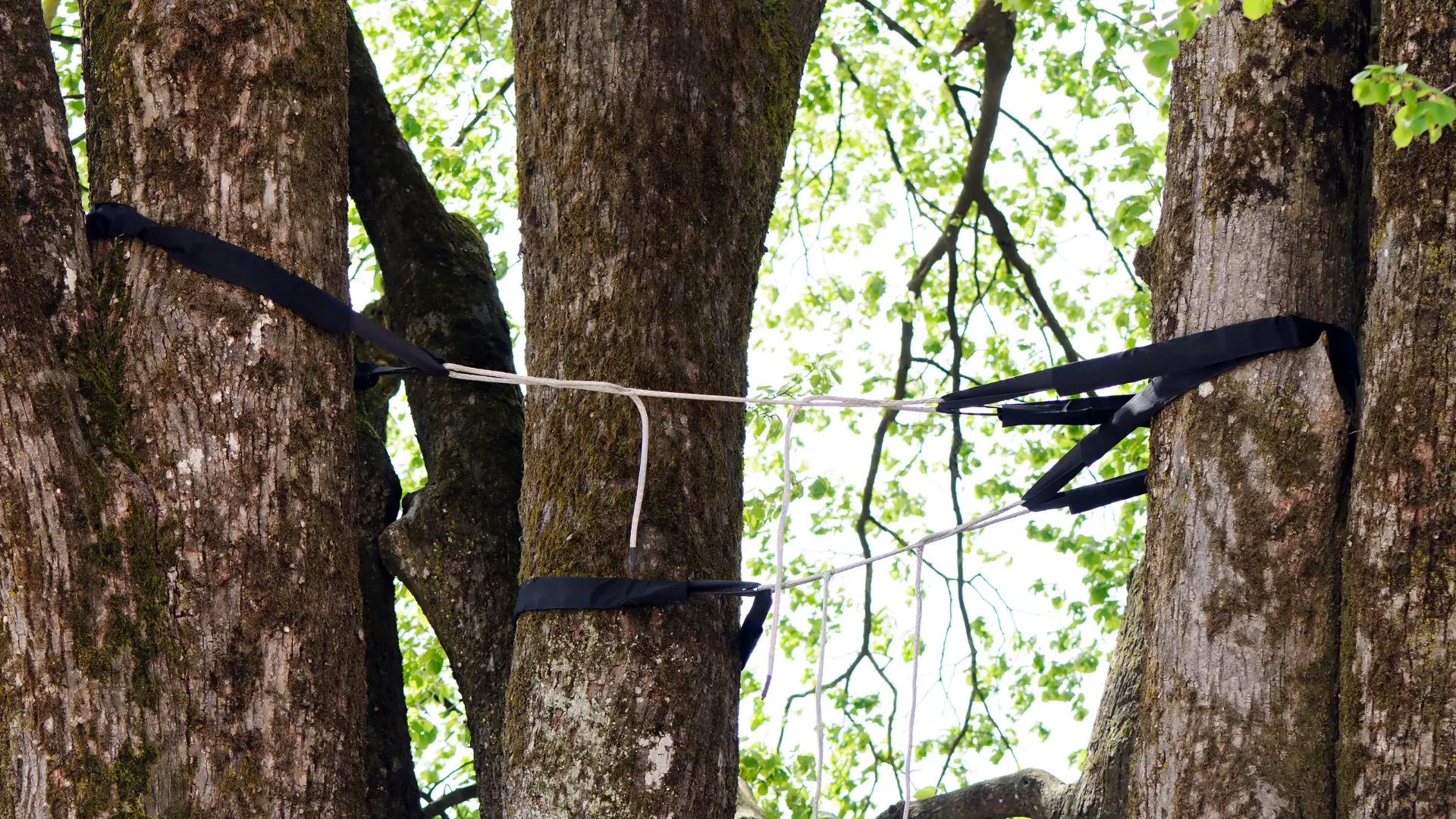

Toronto homeowners can look for several structural warning signs that may indicate a tree needs cabling or another form of supplemental support. Common signs include weak branch unions, cracked trunks, overextended limbs, and a history of branch failure, particularly where the tree is exposed to wind, ice, or heavy snow.
If you notice any of these indicators, arrange a professional assessment before deciding whether cabling is appropriate. Depending on the defect and the tree’s condition, an arborist may recommend cabling, bracing, pruning, removal, or another management option.
Key Takeaways
- Tree cabling can reduce the likelihood of branch or stem failure by providing supplemental structural support to weak parts of a tree canopy and limiting excessive movement. It can be paired with tree bracing, which involves installing rods through split or cracked trunks
- A weak branch union, when two stems of similar size join in a “v” shape, is a common sign a tree needs cabling. Other warning signs include cracked trunks, long horizontal limbs encroaching over structures, previous branch failures, and cracks that open after a storm
- Cabling is designed to be a preventative measure. If a major limb falls, options including tree pruning or removal. Large tree removal is regulated in Toronto.
- Tree support systems should only be specified and installed by a qualified ISA Certified Arborist
Tree Cabling vs Tree Bracing
| Feature | Tree Cabling | Tree Bracing |
| Hardware Used | High-strength steel or synthetic cables. | Threaded steel rods. |
| Placement | Installed high in the upper canopy between stems or limbs. | Installed lower in the tree, directly through a split or weak crotch. |
| How It Works | Limits how far weak branches can move in the wind, reducing load on a defective union without fully immobilizing the tree. | Stabilizes the trunk by physically holding together a crotch or trunk that has begun to split or separate. |
| Primary Goal | Movement restriction and load reduction. | Rigid stabilization. |
| When It Is Preferable | Best for preventive support on weak but intact branch unions (like V-shaped codominant stems) that are vulnerable to wind and heavy canopy loads. | Best for lower trunk defects where the wood has already started to crack, separate, or split apart. |
Similarities & Shared Standards
- They Do Not “Heal” Trees: Neither technique repairs a defect or fuses wood back together. Instead, they redistribute mechanical stress to lower the chances of failure.
- Preventive Nature: Both systems are highly effective as preventive interventions rather than solutions for after a major limb has already fallen.
- Industry Standards: Both are common urban forestry support systems governed by the ANSI A300 (Part 3) standard, published by the Tree Care Industry Association, which dictates how the hardware must be specified, installed, and inspected.
When to Use Both Together
Cabling and bracing are frequently installed together when a tree has a trunk that has already begun to separate. In such a scenario, the bracing rods are driven through the split lower in the tree to provide rigid stabilization, while cables are added high in the canopy to reduce the wind sway and leverage that caused the split in the first place.
Signs a Tree Needs Cabling or Bracing
The following signs are the most frequent reasons arborists specify a support system. If you observe any of them, the appropriate next step is an on-site assessment.
1. Weak Branch Unions
A weak branch union forms when two stems of similar diameter grow from the same point in a tight, V-shaped angle. As both stems thicken, bark becomes trapped inside the joint, preventing the wood from fusing properly. These unions are a common structural defect for which an arborist may specify cabling. Broad, U-shaped unions generally provide better structural attachment than narrow V-shaped unions, particularly when included bark is present.
2. Split or Cracked Trunks
Vertical cracks at or below a major union indicate the union is already failing under load. A split or cracked trunk may require bracing, cabling, or another intervention depending on the location and severity of the defect and the amount of sound wood remaining. Cracks that appear or lengthen after a windstorm should be assessed promptly as separation tends to accelerate once it begins.
3. Long, Horizontal, or Overextended Limbs
Heavy horizontal branches over a roof, driveway, deck, or play area can carry high leverage at their attachment point. Cabling these limbs back to a stronger central leader, sometimes combined with end-weight reduction pruning, lowers the bending stress at the union. Pruning and cabling frequently work together; see Loyal Tree’s tree and shrub pruning service for how canopy weight reduction fits into a support plan.
4. A History of Branch Failure
If a tree has already dropped a significant limb, the remaining canopy often carries similar defects. A history of significant branch failure is an important factor an arborist considers when evaluating the remaining canopy and potential future failure.
5. Decay or Cavities
Cavities, fungal fruiting bodies, or soft, discoloured wood near tree joints can reduce the wood available to hold the joint together. A cable anchored into decayed wood could also provide false security, and as such, evaluation should be done before cabling is performed.
6. Movement or Lean that Changes After A Storm
A tree that develops a new lean, heaving soil at its base, or unions that visibly flex and gap in wind signals active structural change. Some of these cases can be supported with cabling. Particularly in Toronto, some species such as silver maple, Norway maple, willow, and Manitoba maple naturally develop multiple V-shaped stems and fast-grown, weaker wood. An on-site inspection would be necessary in this case to ensure if the tree can be saved. The International Society of Arboriculture’s tree hazard guide for homeowners is a useful reference for what qualified assessors look for.
Why Cabling Matters for Toronto Trees
Toronto’s forested urban areas face a demanding combination of freeze–thaw cycles, ice accretion, and increasingly intense wind and rain events. Such conditions weaken trees where they are most vulnerable: at the points where branches meet other branches or the main trunk. The City of Toronto’s tree program is focused on tree retention where it is possible. Thus, removing or injuring larger trees on private property generally requires a permit, and permits for healthy trees are not granted automatically.
For Toronto homeowners, a properly installed support system achieved via tree cabling allows a structurally compromised but otherwise healthy tree to be retained safely. For a detailed comparison of the two paths, see tree cabling vs. removal in Toronto, and consult our Toronto tree removal permit guide before factoring tree removal as an option.
Where a tree is too far gone to support, professional tree and shrub removal remains the responsible endpoint, but it should always be a conclusion reached after assessment.
What a Professional Cabling Assessment Involves
Specifying a tree support system is an engineering decision, not a hardware purchase. When Loyal Tree’s ISA Certified Arborists assess a tree for cabling and bracing in Toronto, the process typically includes:
- Defect evaluation — identifying weak branch unions, cracks, decay, and load paths throughout the canopy, often including inspection from within the tree.
- System selection — choosing between static (steel) and dynamic (synthetic) systems, and determining whether bracing rods are required in addition to cables.
- Placement and installation — cables are anchored at specified heights in the upper canopy so they carry load efficiently without over-restricting natural movement.
- Companion pruning — reducing end weight on overextended limbs so the hardware is supporting a balanced canopy rather than compensating for one.
- A documented inspection schedule — support systems are not install-and-forget. Hardware should be re-inspected periodically and after major storms, and adjusted as the tree grows.
Improperly placed cables can concentrate stress, girdle stems, or fail without warning. Homeowners evaluating providers should ask specifically about ISA certification, and what an arborist’s ongoing inspection program looks like.
When Toronto Homeowners Call Loyal Tree About Tree Cabling
If you have noticed a V-shaped union, a lengthening crack, or a heavy limb over your home, the next step is to get a professional evaluation. Loyal Tree’s ISA Certified Arborists assess, install, and maintain tree support systems across Toronto, and will inform you of the best course of action. Request an assessment from Loyal Tree to determine whether tree cabling or another support option is appropriate for your tree.
Frequently Asked Questions
How do I know if my tree needs cabling?
Look for a tight V-shaped union between two similar-sized stems, bark pinched inside the joint, vertical cracks at or below a union, long heavy limbs over structures, or a history of branch failure. Any of these justifies a professional assessment. An ISA Certified Arborist can confirm whether cabling, bracing, pruning, or another intervention is appropriate for that specific defect.
How much does tree cabling cost in Toronto?
Cost depends on tree size, canopy access, the number of cables, and whether bracing rods or companion pruning are required. A single-cable installation in a mid-sized tree costs substantially less than a multi-cable system in a large mature maple. Most Toronto arborists, including Loyal Tree, provide a written quote after an on-site assessment rather than pricing sight unseen.
How long do tree cables last?
Properly installed steel cabling hardware commonly remains serviceable for many years, but no system is permanent. Trees grow, loads change, and hardware wears. Industry practice is to inspect installed systems periodically, typically on a recurring schedule and after major storms, and to adjust, replace, or re-tension hardware as the arborist’s inspection findings require.
Is tree cabling better than tree removal?
They solve different problems. Cabling preserves a structurally weak but otherwise healthy tree; removal eliminates a tree that cannot be made reasonably safe. In Toronto, removal of larger private trees also requires a permit under the city’s private tree bylaw. When a tree is viable, cabling is usually less costly and preserves canopy value, but the assessment should come first.
What is the difference between tree cabling and tree bracing?
Cabling installs flexible cables high in the canopy to limit how far weak stems can move apart. Bracing installs rigid threaded rods directly through a split trunk or weak crotch, lower in the tree. Cabling restricts movement; bracing holds separating wood together. The two are frequently installed as one combined support system on trees with split unions.
Can a split tree trunk be saved?
Sometimes. If the split is recent, the tree is otherwise healthy, and enough sound wood remains, an arborist may install bracing rods through the split plus cables above it to remove strain. Extensive decay, a fully separated stem, or a poor overall condition rating usually make removal the safer option. The determination requires an on-site inspection.
Who should install a tree support system?
A qualified tree care professional with appropriate training in tree risk assessment and supplemental support systems should specify and install tree cabling or bracing. An ISA Certified Arborist can assess the tree and determine whether a support system is appropriate. Incorrectly placed or anchored hardware can girdle stems, concentrate stress, and fail under load, creating a hazard worse than the original defect. Cabling is climbing work at height and not a homeowner DIY project.